NESO has made digital architecture and a common language for energy data an important part of its vision for the UK grid. The progressive release of CIM models across Great Britain’s distribution networks offers a concrete view of this shift. Drawing on publicly available datasets from all six GB DNOs and 14 distribution licence areas, this article examines what standardisation solves, what still needs interpretation, and what it takes to make common network data useful in practice.
As DNOs have started publishing their networks using the Common Information Model (CIM), a standard way of describing grid assets and their connections, the starting point has changed. This article looks at what a common model solves, what still needs to be built around it, and what that means in practice.
It standardises the language; applications still have to interpret that language for the problem they are trying to solve.
Building the network once
The appeal of a common network model is straightforward: if every DNO describes its network using the same underlying structure, much of the work spent reconciling incompatible datasets should disappear.
Two years ago, building a usable model of a UK distribution network from open data meant first reconstructing the network itself. Assets had to be matched across files, relationships inferred from names and locations, and each DNO came with its own formats and conventions.
CIM changes that problem. It is not simply another exchange format: it provides a shared model of the grid, with common objects, persistent identifiers and explicit relationships between assets. Instead of each dataset carrying its own implicit representation of the network, there is now a common semantic foundation.
But a common model is not the same as an application-ready representation of the network. It standardises the language; applications still have to interpret that language for the problem they are trying to solve.
The UK rollout makes that visible. DNOs are publishing CIM progressively, view by view. Equipment (EQ) models provide the common description of physical assets and their connectivity, while other views covering geography, operating conditions, topology and electrical state are being added over time. For practical analysis, EQ provides the foundation that can be combined with other DNO publications on geography, network groupings, flows and capacities, connected generation and storage, and parts of the transmission interface.
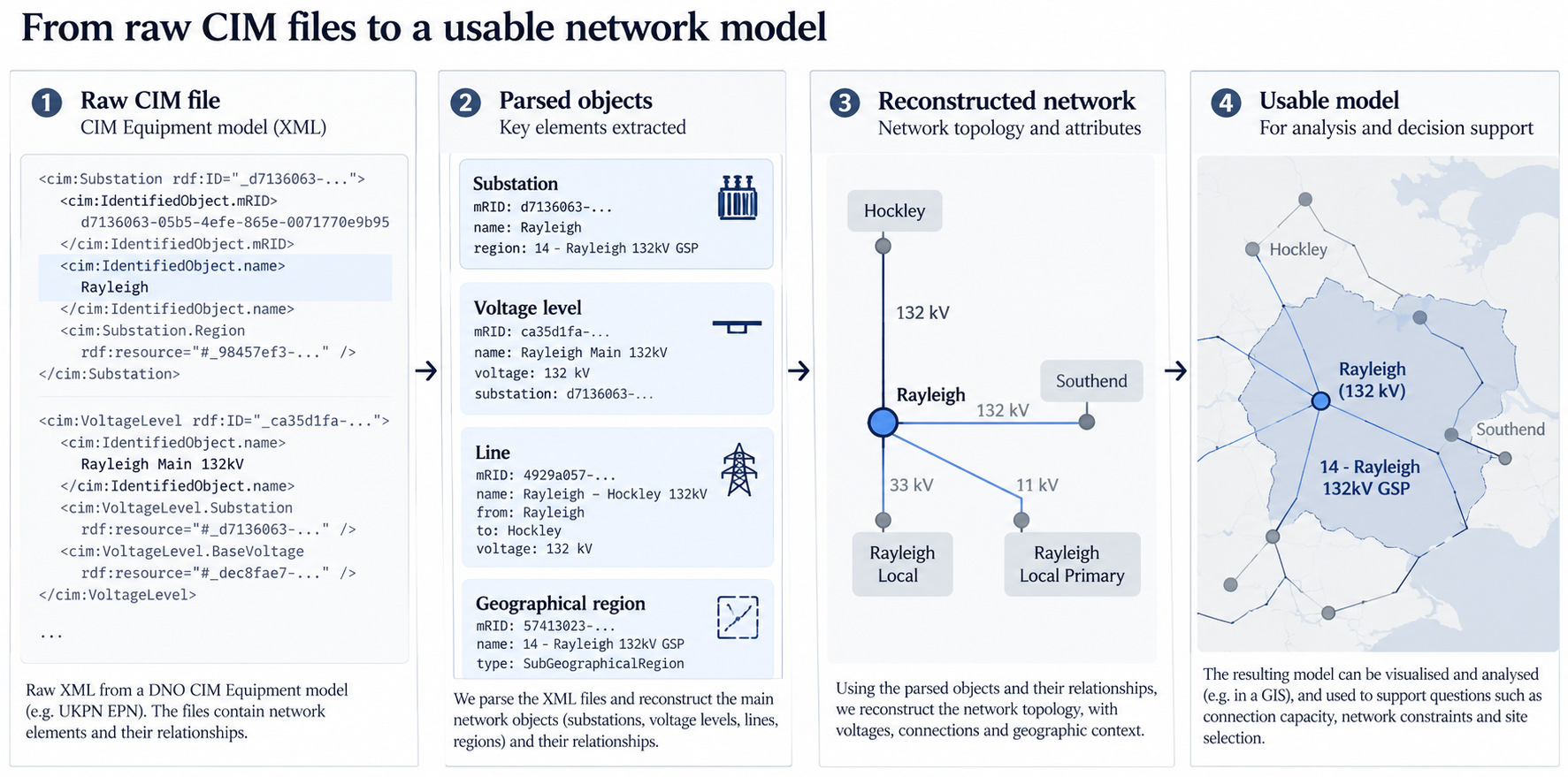
Standardising the network model removes a large amount of unnecessary reinvention. It does not remove the need to interpret that model in context.
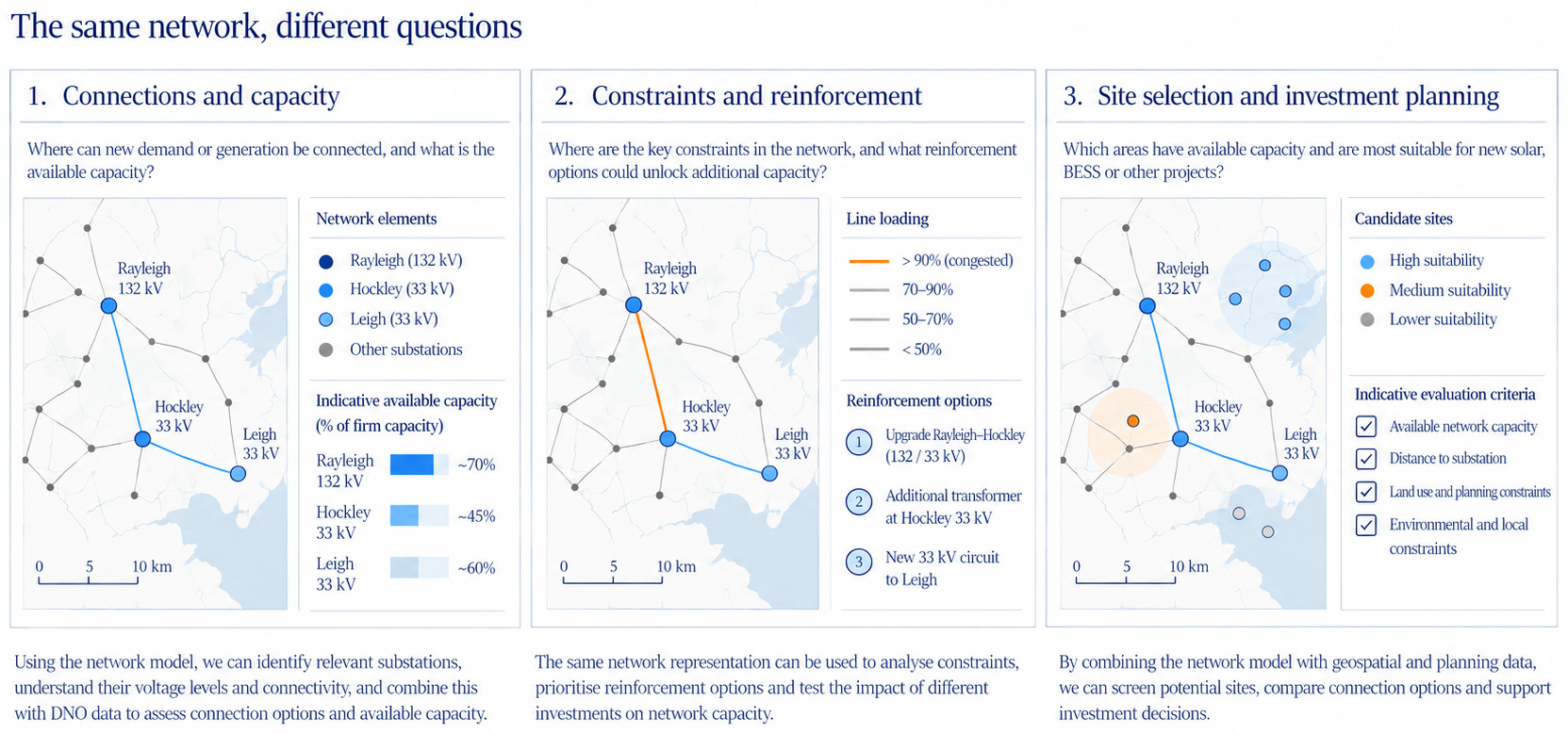
The same network, different questions
A common network model does not mean every user needs the same view of the network. A developer assessing a new site, an IPP prioritising its pipeline or an Independent Connection Provider (ICP) preparing a connection may all start from the same physical network, but the questions they ask are different: where reinforcement may be needed, how much capacity appears to remain, what sits upstream of a site, or which assets may share the same constraint.
Site and connection assessment provides a practical example. For a potential project, the analysis must identify where it could connect, what lies upstream, which circuits and substations matter, what other projects are already connected or contracted, and where capacity or constraints could affect the proposed connection.
In practice, four layers are involved:
EQ provides a description of physical equipment and connectivity: substations, transformers, lines, terminals and connectivity nodes linked through persistent identifiers. From there, the network structure still has to be reconstructed. A path from a potential connection point through a Primary substation, Bulk Supply Point (BSP) and Grid Supply Point (GSP) is not simply stored as a hierarchy; it has to be derived from the underlying connectivity.
Substations illustrate the interpretation still required. CIM provides a standard Substation object, but its identifier does not always match the operational entity relevant for analysis. A single CIM substation can contain transformers playing different roles in the network, while assets that should be analysed together may sit under separate identifiers. For connection assessment, the relevant entity is therefore not always the source Substation object, but its operational role in the network - GSP, BSP or Primary.
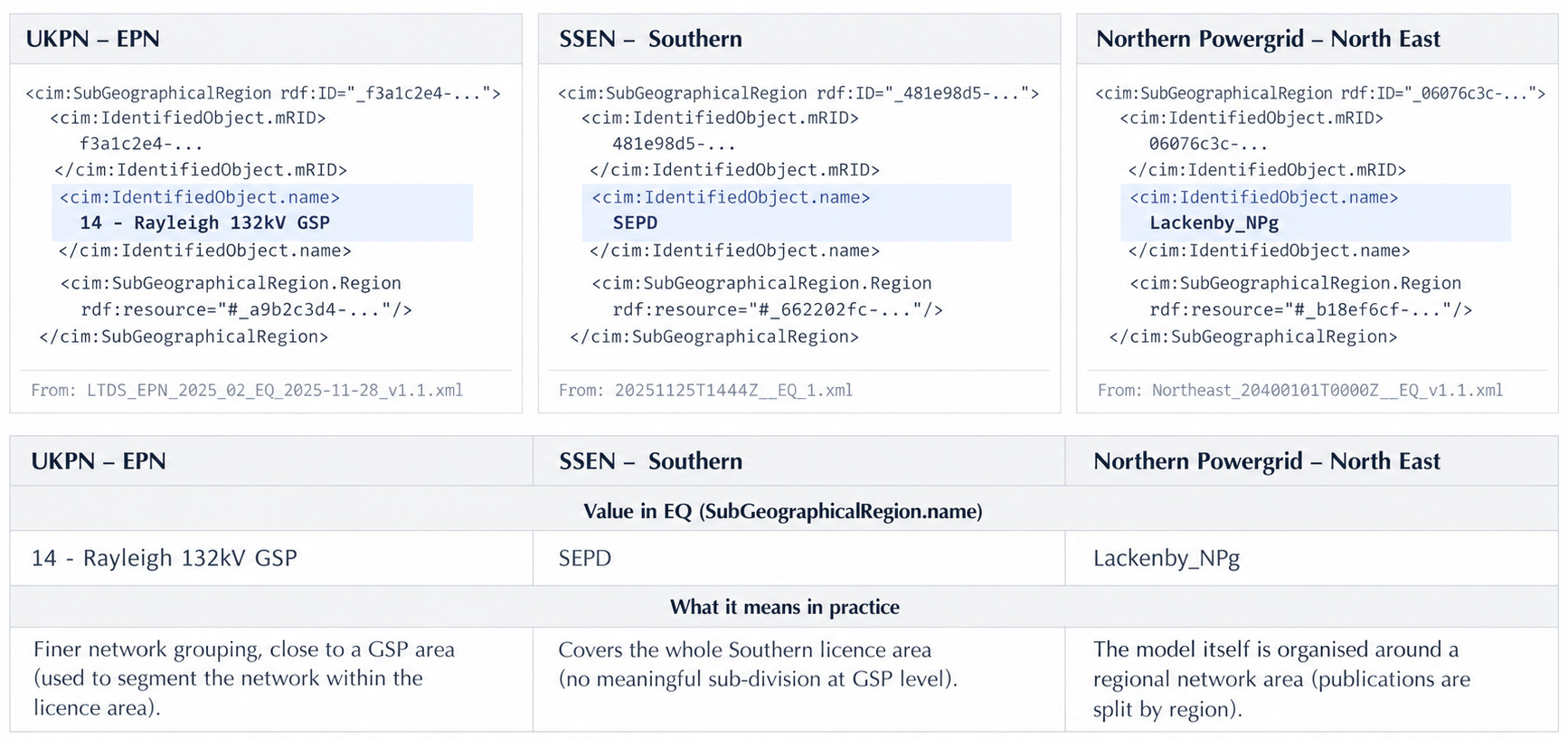
SubGeographicalRegion illustrates a different issue. The field exists across the models, but providers do not necessarily use it to describe the same operational grouping. In UKPN models, it can map closely to a GSP group. In SSEN models, it may cover an entire licence area, providing little useful grouping below that level.
Other providers use it for different forms of network segmentation. The schema is common; the interpretation of a populated field is not necessarily uniform. Other relationships, such as upstream connections or tee and junction points, may require provider-specific interpretation. Connectivity alone is also insufficient: the CIM equipment model needs to be considered alongside geography, transformer flows and capacities, network areas, Embedded Capacity Register data and, where relevant, transmission-level information.
The same CIM object is present across DNO EQ models, but the operational scope attached to it can differ significantly in practice.
Combining these sources makes it possible to build a decision-oriented view of the network. For a potential site, this may involve tracing upstream connections, attaching circuit and transformer capacities, overlaying connected and contracted generation, and identifying potential constraints and apparent headroom.
This is not a replacement for CIM. It is a use-specific view built on top of a common network model, reconstructed and contextualised to answer a particular set of questions.
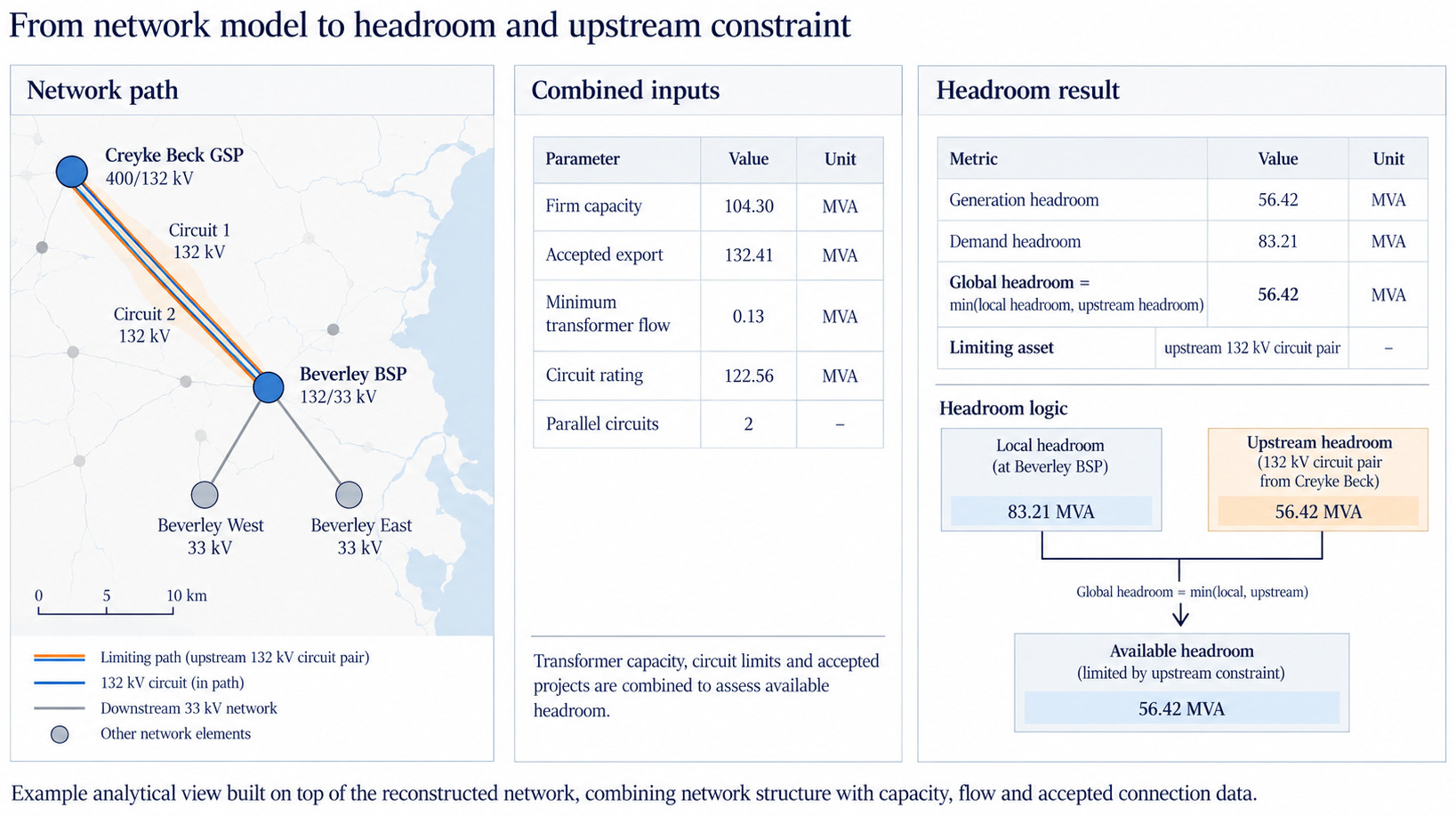
A common model still needs context
The public DNO models illustrate the value of a standard such as CIM. Beyond a shared exchange format, it provides a common model of the network: objects, relationships and persistent identifiers. This gives applications a foundation on which to build, instead of reconstructing the basic network representation from separate files.
But a shared model does not give every user the same interpretation of the grid. Connection assessment, headroom, reinforcement and site selection start from the same physical network but ask different questions of it. Each requires its own view of which entities matter, how they relate and what additional information is relevant.
Some integration challenges will diminish as UK CIM implementations mature and more information moves into common profiles. Others are inherent to applications. Turning a common model into a view suited to a particular decision is application work, not unfinished standardisation.
That distinction matters for NESO’s wider ambition for a digital architecture and a common language for energy data. The objective is not that every application ends up with the same view of the grid. It is that they no longer have to reconstruct the basic language of the grid before building the view they need.